The Driverless Future Is Leaving Us Behind

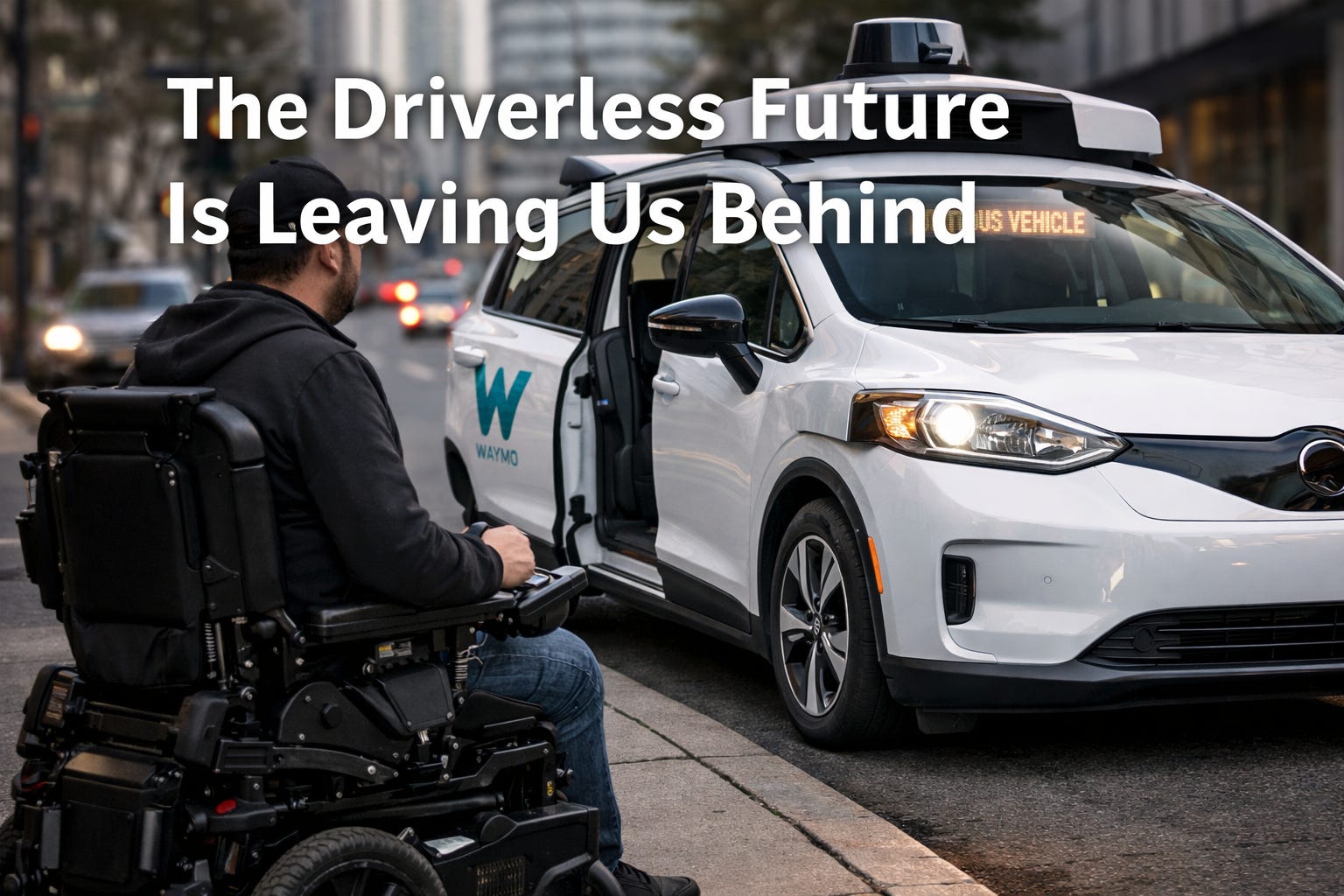
Technology is racing ahead.
Driverless taxis are already rolling through cities like Phoenix and San Francisco. Companies promise a futuristic transportation system where you tap an app and a car shows up. No driver. No conversation. Just you and the road.
For many people, it sounds exciting.
For wheelchair users like me, it sounds familiar.
And not in a good way.
Because once again, a new transportation system is being built without us.
We’ve Seen This Before
When Uber and Lyft launched more than a decade ago, they promised transportation for everyone.
But for wheelchair users, reality was different.
You could open the app and see dozens of cars nearby. But none of them could carry a wheelchair.
Sometimes the wait for an accessible ride was over an hour. Sometimes there was no ride at all.
Many cities tried to fix the problem by requiring rideshare companies to include wheelchair accessible vehicles in their fleets.
But then state governments stepped in.
They passed what are called preemption laws, which prevent cities from creating their own regulations.
The result was simple. Companies could operate everywhere, but cities could not require accessibility.
Disabled riders were left stuck at the curb.
Now It’s Happening Again
Autonomous taxis are the next big thing in transportation.
Companies like Waymo and others are deploying fleets of robotaxis across the United States. These vehicles drive themselves using sensors, cameras, and artificial intelligence.
But here’s the problem.
Most of these vehicles are just regular cars.
No ramp.
No lift.
No securement system.
If you use a wheelchair, you simply cannot enter the vehicle.
It’s not a small design flaw. It’s complete exclusion.
Accessibility Was Never Part of the Plan
This is the frustrating part.
Engineers can design almost anything today.
Cars can drive themselves.
They can park themselves.
They can even update their software overnight.
But apparently adding a ramp is too complicated.
The truth is that accessibility is rarely included from the beginning. It is usually treated as an afterthought.
And once companies build thousands of vehicles, they claim it is too expensive to redesign them.
So the opportunity disappears.
The Irony
Autonomous vehicles could actually be revolutionary for people with disabilities.
Imagine calling a vehicle that arrives with a built in ramp.
Your wheelchair rolls inside.
The vehicle automatically locks your chair in place.
You choose your destination with your voice or phone.
No driver needed. No awkward transfers. No explaining how your chair works.
That kind of technology could give disabled people a level of independence we’ve never had before.
But only if accessibility is built into the system from the start.
The Future Is Being Built Right Now
Right now companies are deciding what transportation will look like for the next fifty years.
If accessibility is ignored today, the consequences will last decades.
Disabled Americans will once again be told to wait.
Wait for the next upgrade.
Wait for the next version.
Wait for someone to care.
We’ve been waiting long enough.
If the future of transportation is going to be autonomous, then it must also be accessible.
Otherwise the driverless future will simply drive right past us.
Your Turn
Transportation is supposed to mean freedom. For many disabled people, it often means frustration, delays, and being left behind.
I know my own stories. I’m sure many of you have yours.
Have you ever waited hours for an accessible ride?
Been denied transportation because of your wheelchair?
Watched car after car drive past while you were stuck on the curb?
I want to hear about it.
Share your transportation experiences in the comments. The good, the bad, and the downright ridiculous.
Your stories matter. They show the world what accessibility really looks like in everyday life.
And sometimes the best way to push for change is simply to tell the truth about what’s happening out there.
Let’s start the conversation.
I wonder if disability activists organizations especially in San Francisco and Phoenix are working on this as well as others like NCIL. Yu bring up a very important issue that needs to be. address now. I wonder how much fed money these companies are getting
When I go to NYC I have had mainly good experiences with WAV Uber, with one exception of being stuck in the UBER for an hour when the ramp wouldn't deploy. Finally my husband used a crow bar and got it to work.
Accessible transportation has impressive in big cities but there are still very limited WAV taxis and probably zero WAV Ubers and Lyfts. It is always a major hassle figuring out Accessible transportation and should be.
Are there grounds for a lawsuit because there is not fair and equal opportunity for those with wheelchairs--invoking the ADA? Yours is the first article I have seen about this.